
BOOKS
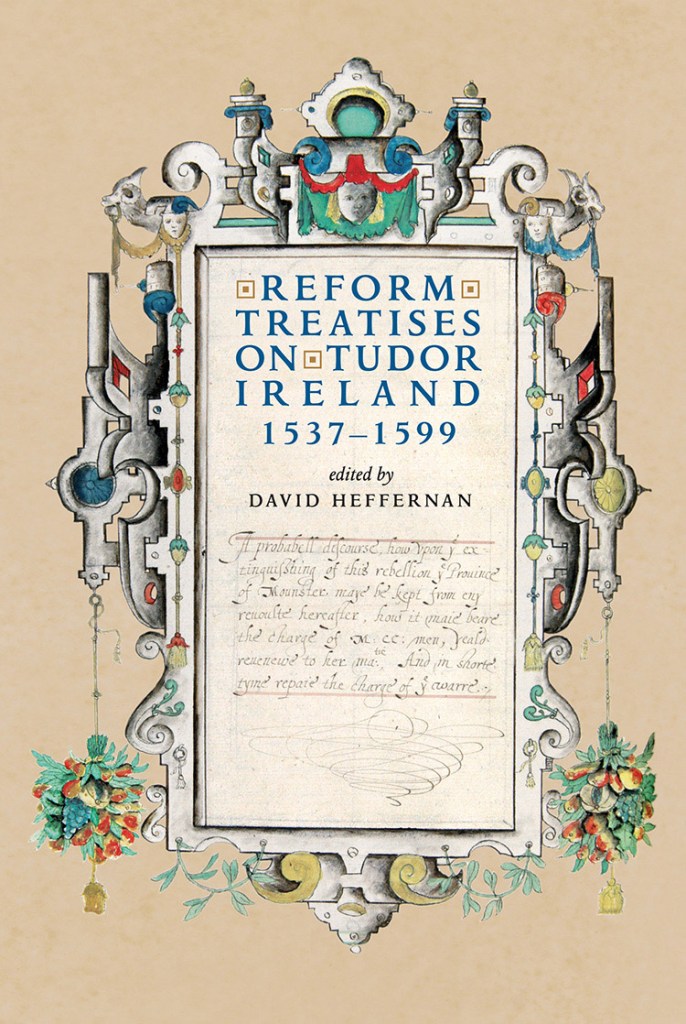
‘Reform’ Treatise on Tudor Ireland, 1537–1599 (Dublin: Irish Manuscripts Commission, 2016)
During the sixteenth century hundreds of treatises were written on the ‘reform’ of Ireland by officials and interested parties active in the country. These documents were central in shaping how senior ministers in England viewed Ireland and consequently how they formulated policy for the second Tudor dominion. This book gathers together 70 of these treatises. In them are to be found proposals for the primary policy initiatives used to bring Ireland more firmly under crown control in the sixteenth century, from the establishment of provincial councils and the settlement of English colonies, to more assimilative schemes such as that to endow an Irish university and Protestantise the country. In addition to articulating policy ideas, these papers provided one of the clearest insights into how Tudor Englishmen perceived Ireland and how they believed it should ultimately be reshaped. The appearance of these hitherto unpublished treatises will contribute significantly to the debate on government policy in sixteenth-century Ireland.
Available to purchase from the Irish Manuscripts Commission — Buy Now
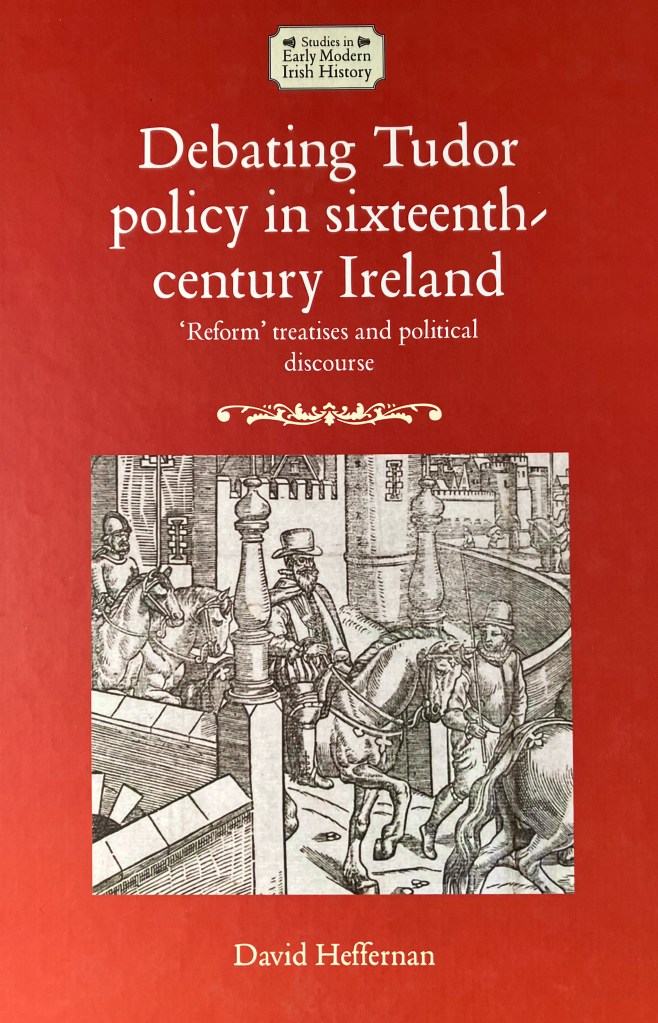
Debating Tudor Policy in Sixteenth-Century Ireland: ‘Reform’ Treatises and Political Discourse (Manchester: Manchester University Press, 2018)
During the sixteenth century hundreds of treatises, position papers and memoranda were composed on the political state of Ireland and how best to ‘reform’, ‘conquer’ or otherwise incorporate the island into the wider Tudor kingdom. These ‘reform’ treatises attempted to identify and analyse the prevailing political, social, cultural and economic problems found in the Irish polity before positing how government policy could be altered to ameliorate these same problems. Written by a broad array of New English, Old English and Gaelic Irish authors, often serving within Irish officialdom, the military, or the Church of Ireland, these papers were generally circulated amongst senior ministers and political figures throughout the Tudor dominions. As such they were written with the express purpose of influencing the direction of government policy for Ireland. Collectively these documents are one of the most significant groups of sources available for the broad history of sixteenth-century Ireland. This book constitutes the first systematic study of these texts. It does so by exploring the content of the hundreds of such works and the ‘reform’ treatise as a type of text, while the interrelationship of these documents with government policy in Tudor Ireland, and their effect thereon, is also explored. In the process it charts the developments from origin to implementation of the principal strategies employed by Tudor Englishmen to enforce English control over the whole of Ireland.
Available for purchase from Manchester University Press — Buy Now
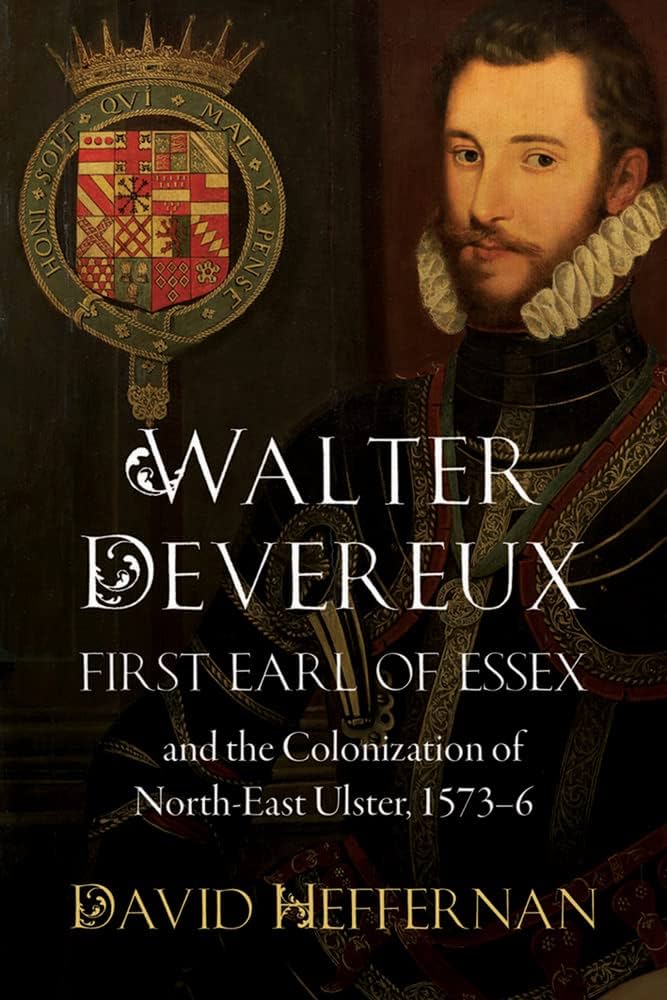
Walter Devereux, first earl of Essex, and the colonization of north-east Ulster, c. 1573–6 (Dublin: Four Courts Press, 2018)
Between the summer of 1573 and the autumn of 1575 one of the rising figures of the Elizabethan court, Walter Devereux, first earl of Essex, attempted to colonize the north-east of the province of Ulster in Ireland. This ‘Enterprise’, as Essex termed it, was undertaken with the aim of prising these lands away from the Irish lords of the region and planting colonies of English settlers there. Essex’s project was to end in utter failure, and his effort has become notorious for the atrocities perpetrated by his forces at Belfast in 1574 and on Rathlin Island in 1575. When Essex died in Dublin in 1576, his personal wealth had been decimated and Ulster remained as firmly resistant to crown encroachments as it had been in 1573. Moreover, the patrimony of his son and heir, Robert Devereux, had been considerably compromised, with major implications for the career of the more infamous second earl. This book presents the first full account of Essex’s ‘Enterprise’. In doing so, it sheds light on the nature of Tudor government in mid-Elizabethan Ireland and the limitations of the early modern state.
Available for purchase from Four Courts Press — Buy Now
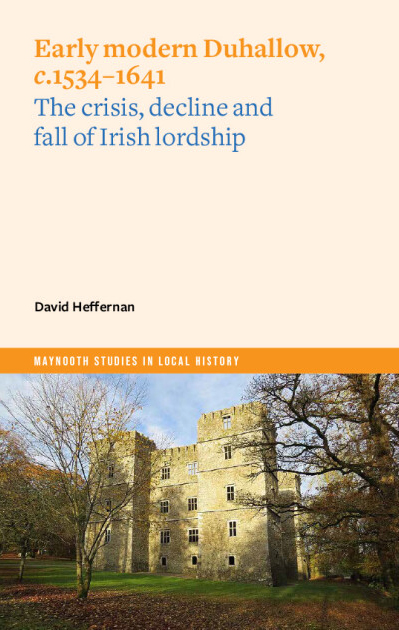
Early modern Duhallow, c. 1534–1641: The crisis, decline and fall of Irish lordship (Dublin: Four Courts Press, 2022)
In the sixteenth century the Duhallow region of north-west Co. Cork was one of the most indisputably Irish parts of Ireland. Characterized geographically by the mountainous boggy lands of Sliabh Luachra, the region was dominated by the lordships of the MacDonogh-MacCarthys, the MacAuliffes, the O’Callaghans and the O’Keeffes. By the mid-seventeenth century, however, these lordships had largely been dismantled and the region was increasingly dominated by New English settler families such as the Boyles, Percivals and Aldworths residing around new towns at Newmarket and Kanturk. This study charts the transformation of early modern Duhallow by examining the crisis of Irish lordship in the region under the Tudors and the decline and fall of the lordships during the early Stuart period. In doing so, it examines a microcosm of how Irish lordship was often destroyed not by direct conquest and colonization, but by a gradual process of economic, social and political erosion.
Available for purchase from Four Courts Press — Buy Now
 Home
Home 